Evan Harris
The Birthday PartyEvan Harris is a psychology professor whose authority as a therapist gives him access to vulnerable young people, while his concern for professional reputation helps keep his conduct hidden. The novel gradually connects his exploitation of Kathy Hamilton and Christine Stiles to the family secrets surrounding Hope Hamilton, later known as Megan Carter, and to Detective Chase Cooper’s accusation that Evan abducted and killed his granddaughter, Charlie Hamilton. The distinction between accusation and proof matters: when confronted about Charlie, Evan denies knowing her and insists that he has no children.
Identity and Public Standing
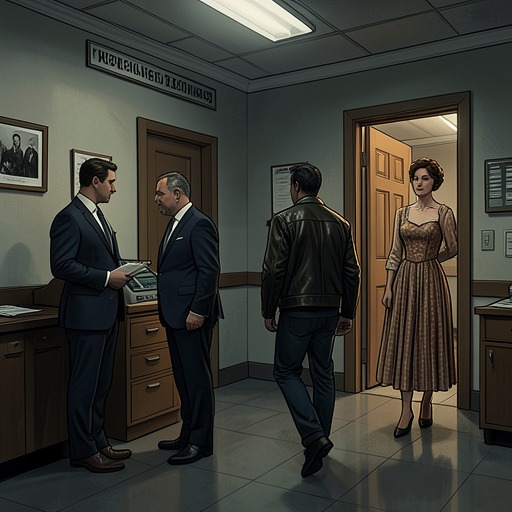
Evan is introduced through two roles that appear to confer respectability: university professor and therapist. Detective Chase Cooper learns that Evan confirmed he had been at a property belonging to Mitch Hamilton on the Saturday night Charlie disappeared. Evan agrees to meet at the university, where he identifies the property and the reason for the interview without requiring Chase to circle around the subject. His appointment and impending departure give their conversation a practical limit, but he initially presents himself as cooperative and composed.
His public standing carries material stakes. Evan has been offered tenure, news of which is expected to appear in the newspaper. Connie Miller knows that a scandal about his conduct with vulnerable girls could put that position at risk. His concern about exposure is made explicit in an earlier relationship with Kathy: he asks her to keep their date secret because other people might consider it inappropriate and invokes his reputation. Professional status is therefore not just background. It is something he actively seeks to preserve, even as the conduct that could destroy it comes to light.
Kathy Hamilton and the Abuse of Therapeutic Authority
Evan’s relationship with Kathy begins in a therapeutic setting, where the imbalance between adult practitioner and young client shapes what follows. He invites her to meet him privately and insists that she conceal the date. He frames secrecy as protection against other people’s judgment, while also reminding her that she has kept an earlier relationship hidden from her parents. The request makes concealment seem like a test of her trustworthiness rather than a safeguard for his own position.
At the meeting, Evan kisses Kathy without warning. The kiss feels forceful rather than tender and frightens her; afterward, she leaves confused. He tells her he needs to write up the notes from their final session, leaving the professional relationship entangled with the private encounter. Kathy considers telling someone what happened, but interprets her mother’s presence outside as another attempt to control her. That anger strengthens her resolve to meet Evan and decide for herself. The scene shows how he exploits a client’s vulnerability and how her own conflict at home makes secrecy easier to impose.
The consequences extend far beyond the therapeutic relationship. Connie later tells Kathy’s father that Evan was the man who got their daughter pregnant. Kathy’s daughter, Hope, was given up for adoption and grew up as Megan Carter. When Megan learns that her birth name is Hope Hamilton, the revelation joins a concealed history of adoption to the account of Evan’s abuse. The family connection that had been kept out of view becomes central to the present-day crisis.
A Pattern of Coercion
Christine Stiles’s account establishes that Kathy’s experience was not an isolated breach. Christine tells Kathy that she was assigned to Evan at thirteen, when he was twenty-nine, and that he raped her the following year. She describes a psychological hold that persisted long after she was young, along with an arrangement in which Evan helped pay for her qualifications and assisted her career. She understood those forms of support as a twisted reward for remaining silent; as the arrangement deepened, she found it harder to live independently.
The pattern links professional care to dependence rather than safety. Evan’s position gives him influence over clients, while money and career assistance can make leaving or speaking out more difficult. Christine’s later work brings her into contact with victims and helps her recognize that the advice she gives others is advice she has struggled to follow herself. Her testimony gives Kathy a way to understand her own experience as part of a repeated abuse of power, not as a private failure to recognize danger.
The novel also includes confidential progress notes concerning a distressed young client. The notes record that the client became more open in therapy, refused to set goals, and did not want to discuss disordered eating. The therapist does not press the issue, reasoning that the client appears to be a healthy weight; the assessment also entertains attention-seeking and normal teenage behavior as explanations. Set beside Christine’s account and Kathy’s experience, this clinical language underscores how a person in authority can interpret distress in ways that minimize it. The notes do not erase the client’s suffering; they show how easily it can be contained within a professional assessment instead of being confronted.
Charlie Hamilton and the Investigation
During the search for Charlie, Evan’s presence at one of Mitch’s properties becomes relevant to Chase’s inquiry. Their interview is initially businesslike: Evan recognizes that Chase wants to discuss the Saturday visit and acknowledges that Charlie has not been found. Later, when construction evidence about a poorly filled hole in a basement floor is raised, Chase accuses him of taking Charlie from the birthday party, bringing her to the Glenwood renovation house, and covering her body with concrete. Chase stresses the horror of the accusation by identifying Charlie as Evan’s own granddaughter.
Evan rejects the accusation. He says that he has no children and has never seen Charlie, claiming to know who she is only from the news. His denial collides with the family history disclosed elsewhere: Connie identifies him as the man who impregnated Kathy, and Hope’s identity as Megan ties that history to Charlie’s family. The confrontation thus brings together two kinds of concealment, the buried evidence at the renovation house and the concealed parentage that makes Charlie Evan’s granddaughter. In the scene, however, the allegation remains an allegation: Chase leaves the room without securing a confession.
Reputation, Secrecy, and Narrative Role
Evan’s story is organized around the gap between respectable appearance and private conduct. The professor approaching tenure, the therapist writing progress notes, and the man who speaks readily with a detective all occupy positions that invite trust. Against that surface, Kathy and Christine describe secrecy, coercion, and a lasting dependence on the adult who had been entrusted with their care. His appeal to reputation is especially revealing because it names the public image he is trying to protect while exposing why exposure matters to him.
The revelations also redraw the story’s family relationships. Evan’s exploitation of Kathy results in a daughter whose adoption and identity remain hidden for years; once Megan learns she is Hope Hamilton, the past becomes inseparable from the search for Charlie. Evan’s denial that he has children sharpens that contradiction, while Chase’s reference to Charlie as his granddaughter makes the concealed kinship impossible to treat as incidental. Evan therefore connects the novel’s private history of abuse to its public investigation, and the authority that once helped him maintain silence becomes part of what the investigation must challenge.